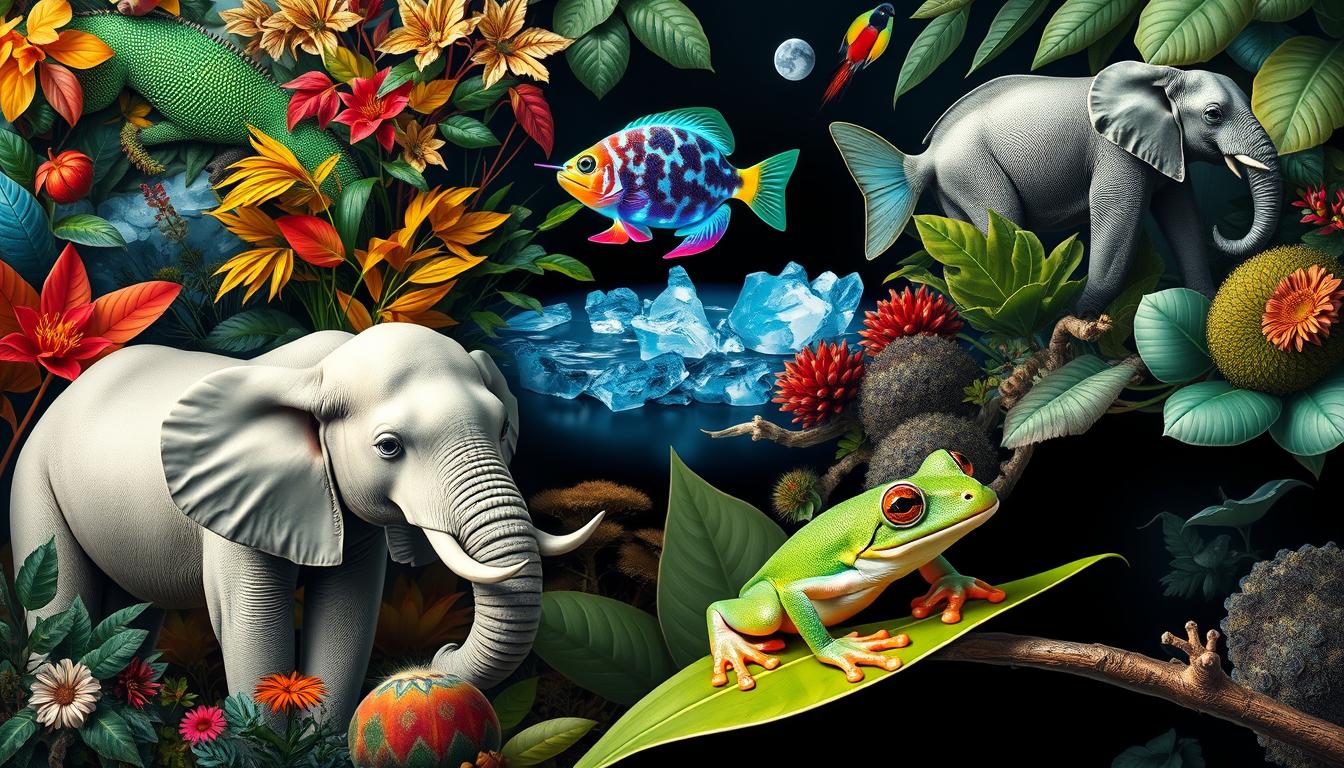
Nature is full of amazing features and survival skills. From the chameleon’s camouflage to the bird’s migration, it’s all incredible. In this article, we’ll explore the unbelievable ways animals adapt to survive in the wild.
Animals use optical illusions to catch prey and live in groups for safety. These clever ways show how nature is full of genius. Get ready to be amazed as we uncover the secrets of the animal kingdom.
Understanding Animal Adaptations
The world of animal adaptations is truly fascinating. It shows the power of evolution. Natural selection and genetic mutations shape the amazing ways animals survive in the wild. As environments change, animals adapt to stay alive.
Natural selection helps us see how some traits help animals survive better. These traits are passed down, making adaptations stronger over time. We see amazing examples like the chameleon’s camouflage and spiders’ webs.
“Adaptation is the process whereby an organism becomes fitted to its environment.”
Genetic mutations can also be good, introducing new traits that help animals survive. These changes can start new adaptations, helping animals reproduce and survive.

Learning about natural selection, genetic mutations, and environmental pressures helps us understand life’s diversity. By studying animal adaptations, we see how living things and their environments interact. It shows the natural world’s strength and ability to adapt.
Incredible Camouflage Techniques
In the natural world, animals have developed amazing camouflage techniques. The chameleon’s cryptic coloration lets it change color to match leaves or bark. Cuttlefish and octopus use cephalopod camouflage to hide in the ocean, changing their skin to look like the sea floor.
Some animals use disruptive patterns to hide. Zebras and Arctic foxes have bold stripes that make it hard to see them. The leaf-tailed gecko and walking stick insect can look just like a branch or leaf, a skill called mimicry.
“Camouflage is about far more than just blending in – it’s about confusing, distracting, and misdirecting the viewer, making it almost impossible to detect the hidden animal.”
These amazing tricks help animals avoid predators and sneak up on prey. They show the incredible ways nature helps creatures survive.

Remarkable Survival Strategies
In the vast natural world, animals have developed amazing ways to survive. The wood frog can freeze solid and then thaw. The tardigrade can survive in the harshest conditions through cryptobiosis. The animal kingdom is full of incredible survival strategies.
The wood frog, found in northern North America, is a marvel. When winter comes, these frogs freeze solid. They produce glucose and urea to prevent ice crystals in their cells. This protects their organs and brain.
When spring arrives, the frog thaws and starts moving again. This shows the power of freeze tolerance.
The tiny tardigrade, or “water bear,” is another amazing creature. It can enter a state of cryptobiosis. This lets it survive extreme temperatures, pressures, and even space.
By shutting down its metabolism, tardigrades seem to defy life’s laws. They reactivate when conditions improve.
The axolotl, a unique salamander from Mexico, can regenerate lost limbs, organs, and even parts of its brain. Its stem cells can change into different cell types. This lets the axolotl easily regrow missing body parts.

From the wood frog’s hibernation to the tardigrade’s estivation, and the axolotl’s regenerative powers, the natural world is full of amazing survival strategies. These show the ingenuity and resilience of life on Earth.
Unusual Feeding Mechanisms
Animals have developed many ways to eat and survive. For example, baleen whales use filter feeding to catch small krill. Anteaters have long proboscis to get termites from their homes. These ways of eating are truly amazing.
The Venus flytrap is a plant that eats insects. It has a special trap mechanism. When an insect touches its trigger hairs, the trap closes. Then, the plant breaks down the insect to get its nutrients.
Even venomous predators like spiders have clever ways to eat. They spin webs to catch prey. This helps them get food in tough places.

These unique ways of eating show how clever nature is. By learning about these, we appreciate the diversity of life more.
Optical Tricks in the Animal World
Animals have developed amazing visual tricks in nature. They can light up like deep-sea creatures or see ultraviolet light. These tricks are truly amazing.
The mantis shrimp is a great example. Its eyes can see polarized light and 12 colors, more than humans. This lets it hunt and avoid predators with great skill.
Some birds and insects can see ultraviolet light too. This lets them spot things we can’t see. It helps them find food, mates, and navigate.
The eyeshine in some animals’ eyes is also fascinating. It’s a glow that comes from a special layer in their eyes. This layer reflects light, helping them see better in the dark. Cats and deer have this glow, showing how amazing nature is.
Navigational Skills of Animals
The natural world is full of amazing feats. Animals show incredible navigational skills. From bats using echolocation to sea turtles sensing the Earth’s magnetic field, animals have unique ways to move and find their way.
Bats fly at night using echolocation. They send out high-frequency sounds and listen for echoes. This helps them map their surroundings in the dark, even in complex places.
Sea turtles can sense the Earth’s magnetic field. This skill, called magnetoreception, guides them on long journeys. They use magnetic cues to find their way back to where they were born.
Birds also have amazing navigation skills. Geese and songbirds use the sun, stars, and other celestial bodies to guide them. This talent helps them travel long distances with great accuracy.
Salmon have a special ability to find their way home. They can smell the scent of their natal streams. This skill lets them return to their birthplaces, even after years in the ocean.
“The ability of animals to navigate their environments with such precision is a true marvel of evolution.”
These examples show just how amazing animal navigation is. From bats to sea turtles, animals continue to amaze us with their incredible abilities.
Social Structures in Animal Communities
The natural world is full of amazing examples of eusociality, cooperative breeding, mutualism, and collective intelligence. These social ways help many species survive and grow all over the world.
Honey bee colonies are a great example. They have a strict order, with one queen leading the hive. Worker bees work together to get nectar, build homes, and take care of the young. This shows a perfect eusocial way of life.
Wolf packs also show amazing cooperative breeding. They hunt together, protect their area, and raise their pups. Their teamwork and smart thinking are truly amazing.
“The whole is greater than the sum of its parts.”
Cleaner fish and their clients are another interesting example. Cleaner fish clean parasites and dead skin from their clients. In return, the clients protect and help them. This is a perfect example of mutualism in nature.
These complex social structures help species survive and grow. They also help keep ecosystems balanced and strong. By studying animal communities, we learn about the amazing ways life has thrived on Earth.
Protection Mechanisms in the Wild
In nature, animals have developed amazing ways to protect themselves from predators. The pufferfish’s venom and the porcupine’s quills are just a few examples. These creatures use chemical defenses and physical features to stay safe.
The pufferfish can grow to several times its normal size. This makes it less appealing to predators. It has a powerful neurotoxin called tetrodontoxin that can be deadly to anyone who eats it.
“The pufferfish’s venom is so potent that it’s estimated to be 1,200 times more lethal than cyanide.”
Porcupines have sharp quills that can be raised to scare off predators. These quills are made of keratin and can hurt anyone who touches them. They can also break off and get stuck in the predator’s skin, causing more harm.
Skunks use chemical defenses to keep predators away. They can release a smelly spray that blinds and weakens their attackers. This spray is very effective, making skunks a strong opponent for many predators.
Some lizards can lose their tails as a defense. When threatened, they can detach their tails. The tail keeps moving and distracts the predator, letting the lizard get away. This shows how clever nature can be.
The Future of Wildlife Adaptations
Our planet is facing big challenges like climate change and habitat loss. These issues are making it hard for wildlife to adapt. But, with conservation efforts and understanding nature, we can help them.
Climate change is a big worry for ecosystems. It’s making habitats less suitable for many species. This means they must adapt quickly to survive. Polar bears and migratory birds are just a few examples of species under pressure.
Yet, nature is incredibly resilient. Many species have found ways to survive and even thrive in tough conditions. By learning from these adaptations, we can help protect vulnerable species. Together, we can keep biodiversity alive and ensure nature’s wonders continue to amaze us.