
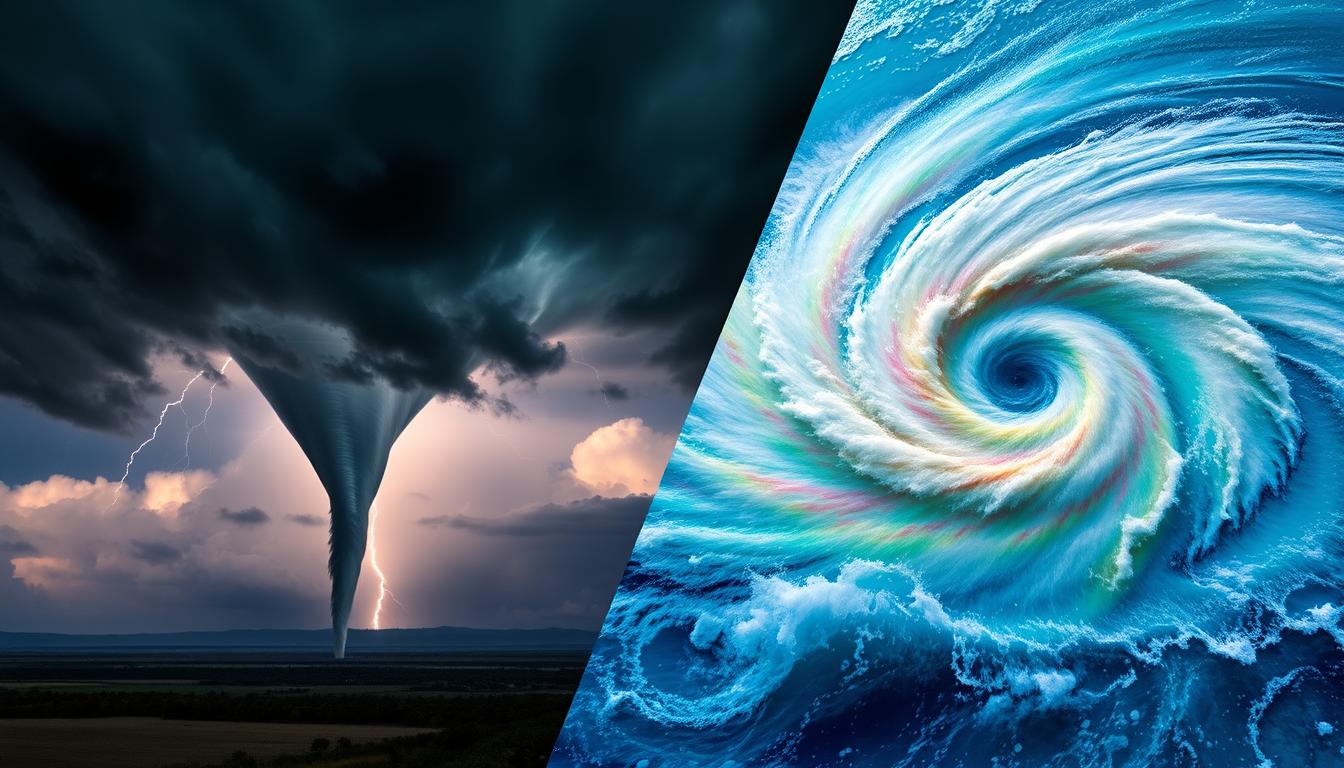
The whirling winds, the rumbling skies, and the awe-inspiring power of nature – these are the hallmarks of tornadoes and hurricanes. They are two of the most captivating weather phenomena on Earth. These extreme weather events have long fascinated scientists, forecasters, and the general public alike.
At their core, tornadoes and hurricanes are manifestations of the intricate dance between temperature, pressure, and moisture. These are the essential ingredients that fuel the formation and evolution of these formidable storms. By delving into the science behind these weather wonders, we can gain a deeper understanding of the forces that shape our environment.
In the following sections, we will embark on an enlightening journey. We will explore the inner workings of tornadoes and hurricanes, their unique characteristics, and the cutting-edge research that continues to shed light on these captivating weather events. From the towering spirals of a tornado to the expansive, spiraling vortices of a hurricane, we will delve into the scientific principles that govern their formation, behavior, and potential consequences.
Whether you’re a weather enthusiast, a student of atmospheric science, or simply someone fascinated by the raw power of nature, this article promises to take you on a captivating exploration. We will explore the fascinating forces behind tornadoes and hurricanes.
Understanding Weather Science: An Overview
Weather science, or meteorology, is a field that explores our atmosphere’s complex workings. It studies atmospheric conditions like temperature, humidity, air pressure, and wind. These factors help create different weather patterns.
Learning the meteorology basics helps us understand natural events like tornadoes and hurricanes. The atmosphere is always changing, with air masses, temperatures, and moisture levels interacting. These interactions lead to various weather systems, from light breezes to strong storms.
Meteorologists study climate study and weather factors to make better predictions. This knowledge helps communities prepare for severe weather, like thunderstorms and hurricanes.
“Weather is a very powerful force of nature, and we’re only beginning to understand its full complexity.”
As we learn more about our atmosphere, meteorology will reveal more about weather patterns. Whether you’re interested in weather science or just want to be ready for storms, this overview is a good starting point.
Tornadoes: The Twisting Winds of Nature
Tornadoes are nature’s most captivating and powerful phenomena. These twisting vortexes of wind are formed when specific atmospheric conditions converge. This creates the perfect storm for their development.
The key to tornado formation lies in the presence of supercell thunderstorms. These storms provide the necessary ingredients for these funnel clouds to take shape.
As warm, moist air rises and interacts with cooler, drier air, the resulting spin and turbulence can lead to the formation of a tornado. The characteristic funnel cloud is the visible manifestation of this powerful rotation. Wind speeds can reach over 200 miles per hour.
The intensity of these storms is measured using the Fujita scale. It ranges from F0 (minimal damage) to F5 (catastrophic destruction).
“Tornadoes are nature’s most violent storms. They can appear suddenly with little warning and can be one of the most destructive forces on Earth.”
Tornadoes are most commonly found in the central United States, known as “Tornado Alley.” This region has unique geographical and meteorological conditions. Understanding the science behind tornado formation is crucial for predicting and preparing for these unpredictable events.
This ensures the safety of communities in the path of these twisting winds of nature.

Hurricanes: Powerful Storm Systems
Hurricanes, also known as tropical cyclones, are truly awe-inspiring and destructive. They form over warm ocean waters, powered by water vapor evaporation and condensation. Warm sea surface temperatures, atmospheric instability, and enough moisture in the air are key for their formation.
As they grow, hurricanes develop a spiral shape with a central “eye.” This eye is surrounded by towering clouds and intense winds. The Saffir-Simpson scale categorizes hurricanes from Category 1 (winds of 74-95 mph) to Category 5 (winds over 157 mph).
“Hurricanes are not just a force of nature – they’re a complex interplay of atmospheric conditions that can have devastating consequences.”
Storm surge is a dangerous aspect of hurricanes. It’s a rapid sea level rise due to the hurricane’s strong winds. This can flood coastal areas, causing widespread damage. High winds and storm surge together can be extremely destructive, as seen in hurricanes like Katrina, Harvey, and Ida.
It’s important to understand tropical cyclones, their formation, and dangers. This knowledge helps coastal communities and emergency responders. By keeping up with hurricane forecasting and preparedness, we can protect ourselves and our communities from these powerful storms.
The Science of Wind Patterns
The Earth’s atmosphere is full of complex global wind systems. These systems shape our weather patterns. Understanding these wind patterns is key to predicting and preparing for severe weather.
The Earth’s rotation, temperature, and pressure differences drive wind formation. Warm air rises, cool air sinks, creating a flow of air. The Coriolis effect, caused by the planet’s rotation, influences this flow. This interaction creates major wind systems like jet streams and trade winds, as well as local wind phenomena.
“The atmosphere is the breath of the Earth, and the winds are its heartbeat.”
Jet streams, fast-moving air rivers at high altitudes, steer weather systems and influence storm tracks. Trade winds, blowing from the northeast in the Northern Hemisphere and the southeast in the Southern Hemisphere, regulate global climate patterns.
Knowing the science behind wind systems is vital for weather forecasting, disaster preparedness, and renewable energy planning. By studying global and local wind patterns, scientists can predict severe weather better. This helps communities stay safe.

The Connection Between Tornadoes and Hurricanes
Tornadoes and hurricanes may seem very different, but they are connected. When hurricanes hit land, they can create tornado outbreaks. These outbreaks make the storm even more destructive.
Inside a hurricane, the spinning winds and unstable air are perfect for hurricane-spawned tornadoes. These tornadoes may not last long but can still cause a lot of damage. They are a big threat to areas in the hurricane’s path.
Mesoscale convective systems also play a key role. These are big thunderstorm complexes that can start tornado outbreaks. They can make the hurricane’s severe weather worse, leading to more tornadoes.
“The interaction between hurricanes and tornadoes is a complex and dynamic process, with the potential to create some of the most destructive weather events on the planet.”
It’s important to understand how tornadoes and hurricanes are connected. This knowledge helps forecasters, emergency teams, and communities at risk. By staying informed and ready, we can face the challenges of these storms together.
Atmospheric Conditions That Create Storms
To grasp how tornadoes and hurricanes form, we need to look at key atmospheric factors. Instability, moisture, lift, wind shear, and convection are crucial. These elements help create intense storm systems.
Instability in the atmosphere, due to temperature and humidity differences, gives storms the energy to grow. Moisture in the air is also vital. It acts as fuel for cloud and rain formation.

Lift is another key factor. It can come from fronts, mountains, or the sun’s heat. This lift pulls moisture up, starting convection.
Wind shear, changes in wind speed or direction with height, is also important. It helps storms spin, like tornadoes and hurricanes’ spiral bands.
The mix of these conditions makes severe weather events likely. Knowing how these systems work helps us prepare for and deal with extreme weather.
Advances in Weather Forecasting
Weather prediction has seen huge leaps forward, making it more accurate. Tools like Doppler radar, satellite imagery, and computer modeling are key. They help meteorologists understand and predict severe weather like tornadoes and hurricanes.
Doppler radar tracks storms in real-time, giving crucial info on wind and rain. Satellites give a big-picture view of weather, helping forecasters see large weather patterns.
These tools work together with computer models to improve forecasts. They analyze lots of data to predict weather accurately. This helps warn communities of dangers early.
“The advances in weather forecasting have not only improved our ability to predict severe weather, but they have also saved countless lives by allowing people to prepare and respond more effectively.” – Dr. Emily Winters, Meteorologist
Even with these advances, there’s still work to do. Research in Doppler radar, satellite technology, and computer modeling keeps improving weather prediction. This ensures we stay ahead of nature’s strongest storms.
Climate Change and Extreme Weather
The Earth’s climate is getting warmer, and scientists are looking into how this affects extreme weather. They think warmer temperatures might make storms stronger, like hurricanes and tornadoes.
Research shows climate change is changing weather patterns worldwide. It’s making hurricanes last longer and be more destructive because warmer oceans give them more energy. Also, global warming might change where and when tornadoes happen.
“The scientific evidence is clear: climate change is impacting extreme weather events and making them more severe. We must take action to mitigate the effects of global warming and prepare for the challenges ahead.”
It’s hard to say if one storm is caused by climate change, but the trend is clear. As the planet warms, we’ll see more intense storms and weather events. Knowing this helps communities get ready for climate change.
Safety Measures During Severe Weather
When severe weather hits, being ready is key. Emergency preparedness helps you face the storm. Having a disaster kit with food, water, and first-aid is crucial.
Storm shelters are vital during tornadoes and hurricanes. They protect you from strong winds and debris. Knowing where the nearest storm shelter is and how to get there fast is important.
Listening to weather alerts and evacuation orders is vital. Local news and emergency broadcasts give you storm updates. This helps you decide when to leave.
“The best way to stay safe during a severe weather event is to be proactive and have a plan in place. Don’t wait until the last minute to prepare – it could mean the difference between life and death.”
By taking these steps, you can stay safe during severe weather. Remember, being prepared is the best way to survive.
Famous Tornadoes and Hurricanes in History
The history of meteorology is marked by devastating storms. The Great Hurricane of 1900 hit Galveston, Texas, hard. The Dust Bowl storms of the 1930s also left a lasting impact.
Hurricane Katrina in 2005 is a recent example. It caused huge damage along the Gulf Coast. Over 1,800 people died, and damages reached more than $125 billion.
Katrina’s impact led to big changes in how we prepare for disasters.
“Hurricane Katrina was a wake-up call for the nation, highlighting the devastating consequences of extreme weather events and the need for comprehensive disaster planning.” – Dr. Michael Mann, Climatologist
The Dust Bowl of the 1930s is another key event. It was a series of severe dust storms in the Great Plains. These storms were caused by drought and bad farming practices.
They forced thousands to leave their homes. The Dust Bowl era teaches us about climate change and land management.

Our knowledge of weather keeps growing. The lessons from these storms are still important today. By learning from the past, we can face future challenges better.
Educational Resources for Weather Science Enthusiasts
If you love learning about tornadoes, hurricanes, or weather patterns, you’re in luck. There are many educational resources out there. You can find meteorology courses and the latest weather apps to explore.
Looking for a deeper dive? Many universities and online sites offer meteorology courses. These cover weather forecasting, climate change, and more. Plus, you can join citizen science projects to help with weather research.
For thrill-seekers, storm chasing is an exciting adventure. But, it needs special training and safety steps. Always check the rules and ethics of storm chasing first.
Today’s tech has changed how we see the weather. Weather apps and websites give us live updates and forecasts. They make it easy to stay informed about the weather.
“The best meteorologists are those who combine a deep understanding of the science with a passion for sharing their knowledge.”
Whether you want to work in meteorology, join citizen science, or just learn more, there’s help available. Today’s resources make exploring weather science easier than ever.
The Future of Weather Science Research
The world is facing big challenges from climate change. Weather science research is looking to the future with hope. Scientists are working on new ways to predict the weather for longer periods. They are using big data and machine learning to understand the atmosphere better.
There’s also a lot of interest in weather modification. People are talking about using cloud seeding and other methods to change the weather. Even though it’s still a topic of debate, research could find new ways to deal with severe weather.
Artificial intelligence in meteorology is becoming more important. AI can make weather forecasts more accurate and timely. This could help us prepare for emergencies and respond to disasters faster.