
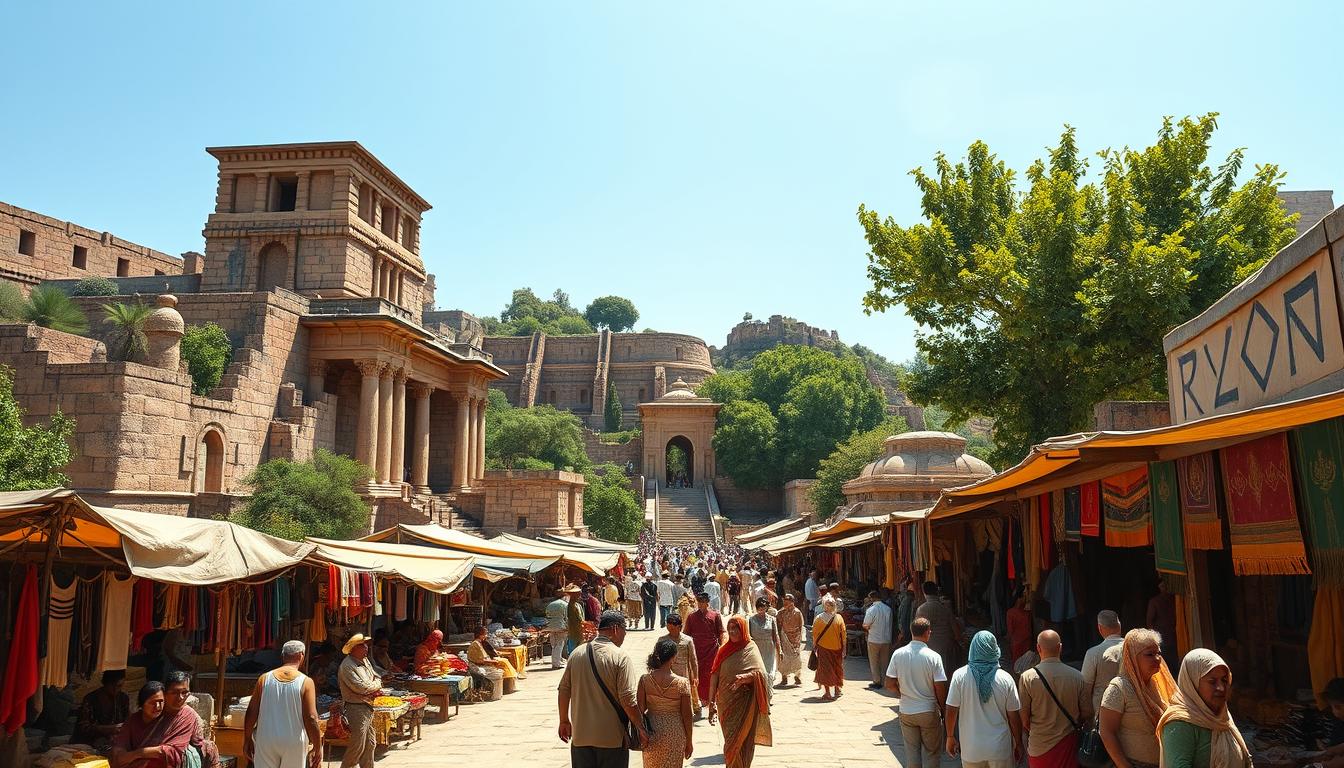
Explore the fascinating lives of our ancestors in this journey through ancient civilizations. We’ll see how people lived in Mesopotamia’s markets and Egypt’s architectural marvels. These stories shaped our world today.
Be amazed by the creativity and strength of our ancestors. We’ll visit ancient Greece’s creative center and Rome’s economic might. We’ll also learn about women’s roles and the religious practices that brought these societies together.
Get ready to be amazed by ancient innovations. From transportation to festivals, these cultures changed our world. Let’s uncover ancient history’s secrets and honor our ancestors’ legacy.
Daily Life in Ancient Egypt
Imagine a time when the Nile River’s waters nourished the ancient Egyptians. They shaped their daily routines and built a rich civilization. From bustling cities to serene rural areas, their lives were ruled by the river and their pharaohs.
Agriculture was key to their society. The Nile’s floods made it perfect for growing crops. Farmers worked hard, growing wheat, barley, and vegetables. Meanwhile, artisans created detailed hieroglyphics to tell their history and beliefs.
The social hierarchy was important. Pharaohs were seen as divine rulers. They were respected and followed by their people. These people worked hard to build the famous pyramids and other structures.
“The Nile River was the lifeblood of ancient Egypt, sustaining its people and shaping their daily routines for centuries.”
Religion was central to their lives. They believed in many gods and goddesses. Gods like Ra and Bastet were honored through rituals and grand temples.
The ancient Egyptians lived close to nature and their gods. They fished, tended to animals, and enjoyed cultural activities. Their legacy still inspires and fascinates people worldwide, showing us a remarkable civilization.
Work and Occupations in Ancient Mesopotamia
The Fertile Crescent was a key area in ancient times. It included Mesopotamia and was full of different jobs and new ideas. The Sumerians were at the center of this, making big steps in farming, writing, and building cities.
Farming was very important in Mesopotamia. The Sumerians found ways to use water from the Tigris and Euphrates rivers to grow crops. Craftsmen like potters and metalworkers made important items. But scribes were especially important. They learned to write in cuneiform and recorded important Sumerian texts.
Cities in Mesopotamia had many jobs. Architects and engineers built huge ziggurats, which were temples and government buildings. Priests and scribes worked there, keeping the Sumerian culture and knowledge alive.
“The scribes of Mesopotamia were the keepers of knowledge, recording the history, literature, and administrative records of the Sumerian civilization.”
The work and ideas of ancient Mesopotamia helped us today. They invented the wheel and the first writing. The Sumerians and others in the Fertile Crescent were key in shaping our world.

The Role of Women in Ancient Civilizations
Women played different roles in ancient civilizations. From the powerful gender roles of Egyptian queens to the influential matriarchal societies of Native American tribes, women’s impact on history is clear.
In ancient Egypt, women’s rights in antiquity were quite advanced. Queens like Cleopatra and Nefertiti had a lot of power. They led armies and shaped their societies, leaving a lasting impact.
“In ancient Egypt, women enjoyed a level of social and economic independence that was unparalleled in the ancient world.”
In ancient Greece, women’s roles were more limited. They mainly focused on home and religious duties. But, women like Pythia and Aspasia broke through, challenging gender norms.
The variety of women’s experiences in ancient times shows the complexity of history. By looking at these stories, we understand more about gender, power, and how civilizations evolved.
Ancient Greece: A Hub of Creativity
Ancient Greece is a bright spot in human history. It was a time of great change in philosophy, democracy, the Olympic Games, and the arts. These areas still excite and inspire us today.
The start of democracy in ancient Greece was a big deal. The Athenians created a system where people had a say in government. This idea is still important today. Thinkers like Socrates, Plato, and Aristotle explored big questions about life and knowledge.

The Olympic Games were also born in ancient Greece. These games celebrated human strength and spirit. They showed the best of sports and fair play.
“The whole earth is the sepulchre of famous men; not only are they commemorated by columns and inscriptions in their own country, but in foreign lands there dwells also an unwritten memorial of them, graven not on stone but in the hearts of men.” – Pericles, Athenian statesman
The art and writing of ancient Greece still touch our hearts. Homer’s poems and Sophocles’ plays have shaped Western culture. Their work in architecture, sculpture, and painting is also awe-inspiring.
The legacy of ancient Greece shows our endless creativity and curiosity. Exploring this civilization, we find a source of inspiration. It helps us understand the world and our role in it.
Trade and Economy in Ancient Rome
The Roman Empire was a major power in the Mediterranean for centuries. Its economy was key to its success. It had a wide trade network that connected provinces and allowed for the exchange of goods.
The Roman currency, the denarius, was a silver coin that was central to the empire’s finances. It made trade and commerce efficient. But, the economy also relied heavily on slaves, who worked in many industries.
Despite using slaves, the Roman economy was complex and varied. Goods from all over were traded through the empire’s extensive trade routes. This not only made the empire wealthy but also helped in cultural and technological exchange.
“The Romans were masters of organization and efficiency, and their economic prowess was a key factor in the expansion and longevity of their empire.”
The Roman economy’s legacy is still seen today in banking, commerce, and currency use. Learning about the Roman economy helps us understand our modern economic systems better.
Religious Practices Across Civilizations
Ancient civilizations were a mix of different religious beliefs. They ranged from the many gods of ancient Egypt and Greece to the single God of Mesopotamia and Judea. Religion played a big role in how societies were organized and in everyday life.
In many old cultures, temples and shrines were the heart of religious life. Priests and priestesses led complex rituals and ceremonies there. These places were not just for worship but also for learning, keeping sacred texts, and even managing the community.
“Religion was the glue that held ancient societies together, guiding their moral compasses and providing a framework for understanding the natural world.”
Religion touched every part of life, not just in temples. It was believed to influence everything from farming to war. Communities held festivals, made sacrifices, and used divination to keep the gods happy and on their side.

As time went on, religions changed too. The move from many gods to one God in the Near East changed worship and how people saw the divine. This change affected philosophy, ethics, and politics, shaping the ancient world.
Warfare and Military Life in Ancient Societies
Warfare and military life were key in shaping ancient civilizations. The ancient weapons and military strategies of warrior cultures are well-known. These stories of conflict and conquest are part of our history.
In ancient Egypt, pharaohs led armies with bows, spears, and chariots. This helped them expand and defend their lands. Mesopotamia, where writing started, also saw the rise of organized armies. They used siege weapons and smart tactics.
“War is the father of all things, and the king of all.” – Heraclitus, ancient Greek philosopher
The ancient Greeks changed warfare with their hoplite soldiers and the phalanx formation. This was key in many famous battles. The Romans, with their legions and ancient weapons, conquered a lot of land. They shaped Western civilization.
Warrior cultures in these societies were not just about fighting. They also shaped society, politics, and technology. Learning about warfare and military life in ancient times is fascinating. It shows us the fierce battles and great innovations of those times.
Innovations and Inventions of Ancient Cultures
The ancient world was full of scientific discoveries and engineering marvels. These continue to shape our lives today. The Babylonians were known for their precise astronomical calculations. The Egyptians amazed us with their architectural feats.
The Antikythera mechanism is a remarkable ancient technology. It was a Greek device used to predict the sun, moon, and planets’ movements. Dated to around 100 BCE, it’s the world’s first known analog computer. Its advanced engineering and knowledge of astronomy were far ahead of its time.
“The Antikythera mechanism is the most sophisticated piece of machinery we’ve found from the ancient world.”
The Hanging Gardens of Babylon are another ancient innovation. They were one of the Seven Wonders of the Ancient World. This impressive garden defied gravity with its multi-tiered design and advanced irrigation system.

These ancient innovations show the incredible abilities of our ancestors. Their work in mathematics, astronomy, and engineering still inspires us today. It reminds us of the deep ingenuity of humans.
Housing and Living Conditions Throughout History
The journey of housing and urban development is fascinating. It spans from ancient Egypt, Mesopotamia, and Greece to the Roman Empire. These cultures built impressive buildings and showed new ways to plan cities and manage waste.
In ancient Egypt, the rich lived in huge palaces with detailed ancient architecture. The poor lived in simple mud-brick homes, often in organized urban planning areas. The Egyptians also created advanced sanitation systems, like drainage and waste disposal.
“The architecture of ancient civilizations reflected their social hierarchies, with the elite enjoying lavish dwellings while the masses lived in more humble abodes.”
In ancient Mesopotamia, cities had grand temples, government buildings, and homes. The rich had big houses with gardens, while the poor had smaller, crowded homes. They also built sewage systems and waste facilities.
The ancient Greeks were known for their culture and intellect. Their cities were laid out in grids, showing the value of urban planning. Homes varied from simple to large, with the rich having the biggest and best.
As time went on, housing and living conditions kept improving. The search for better ancient architecture, urban planning, and sanitation systems has always been key. It has shaped how people live and thrive in their environments.
Transportation Methods in Ancient Times
Ancient civilizations were skilled in transportation. They built roads and mastered sea trade. The wheel’s invention changed land travel, leading to carts and chariots.
The Egyptians used animals for transport. Donkeys and oxen pulled heavy loads. Camels were great for the desert. The Nile River helped move goods and people.
Mesopotamians built roads and trade routes by the Tigris and Euphrates rivers. These paths connected distant places. They also shared ideas and cultures.
Shipbuilding was key in ancient times. The Phoenicians built ships for the Mediterranean. They traded goods and animals across the sea.
Transportation was vital for ancient societies. It shaped their economies, societies, and cultures. The wheel and ancient networks helped create today’s global world.
Festivals and Celebrations in Ancient Cultures
Ancient civilizations around the world were known for their lively religious holidays and harvest festivals. These events were more than just fun; they were deeply meaningful. They held spiritual, social, and historical importance for the people who celebrated them.
In ancient Egypt, the Opet Festival was a joyous event. It honored the god Amun-Ra and the pharaoh’s divine right. Across Mesopotamia, the New Year’s festival of Akitu was a time for renewal. It had elaborate rituals and feasting, showing the region’s love for agriculture.
“The festivals of ancient civilizations were not mere diversions, but rather intricate tapestries that wove together the threads of their cultural identity.”
The Greeks loved theater and held annual competitions for playwrights, poets, and musicians. The Romans had many festivals, like Saturnalia and Lupercalia. Each festival showed their unique mix of religious and civic traditions.
These festivals brought people together and helped share cultural values. They kept traditions alive and celebrated the natural world. Learning about these ancient festivities helps us appreciate the rich history of human civilization.
Learning and Knowledge in Ancient Schools
In ancient times, schools were key in teaching people to read and write. They helped keep knowledge alive and made famous scholars. In ancient Egypt, scribes were important for keeping records and passing down traditions through writing.
The library at Alexandria, started in the 3rd century BCE, was a major place for learning. It had many scrolls and attracted scholars from all over the Mediterranean.
In ancient Mesopotamia, schools taught the cuneiform writing system. These schools, called “edubas,” trained scribes. They helped keep the region’s knowledge in fields like math, astronomy, and law.
The ancient Greeks also valued education a lot. Famous thinkers like Socrates, Plato, and Aristotle started schools. These places encouraged thinking, talking, and seeking wisdom, shaping the ancient world’s thinking.
The library at Pergamum was a big rival to Alexandria’s library. It was another important place for ancient knowledge.